
Opening the dishwasher to find a pool of dirty water is frustrating, but most drainage problems come from a short list of causes. Several of them take ten minutes and no tools. Work through this list in order.
Before You Start
Turn off the dishwasher and switch off its breaker (or unplug it under the sink). Put towels on the floor and keep a cup, sponge and bucket nearby. Check for broken glass before putting your hands into the sump.
1. A Clogged Filter
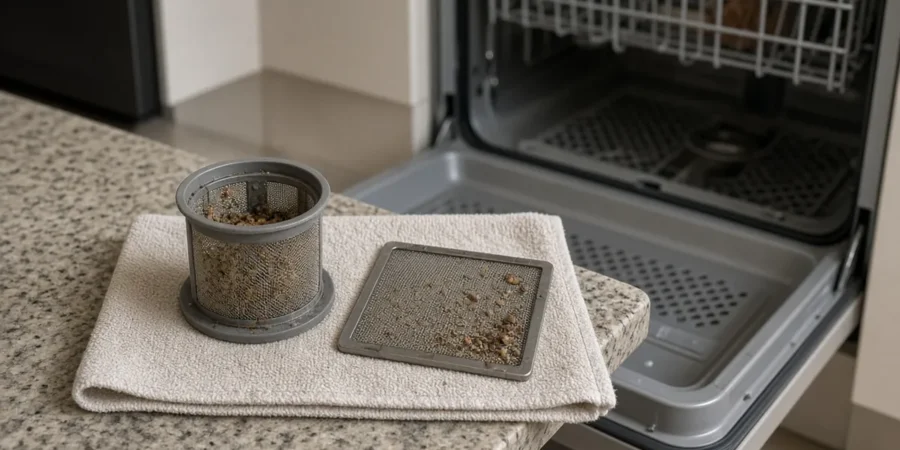
This is the most common cause by far. Most modern dishwashers have a manual filter at the bottom of the tub that needs regular cleaning. When it’s packed with food, water drains slowly or not at all.
- Remove the bottom rack.
- Twist and lift out the cylindrical filter, and remove any flat mesh filter under it.
- Rinse under warm water and scrub gently with a soft brush. Don’t use wire brushes.
- Refit the filters and make sure they lock in place.
Some brands warn you before it gets bad. Frigidaire and Electrolux dishwashers commonly use i40 for a clogged filter, and Bosch uses E22.
2. A Kinked or Crushed Drain Hose
Follow the drain hose under the sink. If the dishwasher was recently installed or pushed back, the hose may be bent or crushed behind it. Straighten what you can reach.
3. A Blocked Garbage Disposer or Sink Drain
Most dishwashers drain into the garbage disposer or a branch of the sink drain. If the disposer is full or the sink drain is slow, the dishwasher can’t empty.
- Run the disposer with cold water for a few seconds.
- If the disposer is newly installed, check that the plastic knockout plug in its dishwasher inlet was removed.
- If the sink itself drains slowly, clear the household drain first.
4. A Clogged Air Gap
Some kitchens have a small chrome cylinder on the countertop or sink deck called an air gap. It prevents dirty sink water from siphoning back into the dishwasher. If it’s clogged, water may spill out of it or the dishwasher may not drain. Pull off the cover, remove the cap, and clear any debris.
5. Debris in the Drain Pump
Below the filter, there’s a drain pump that pushes water out. Glass, pits, bones, and bits of plastic can jam it. On many models, there’s a removable cover under the filter that lets you reach the pump impeller.
- Bail out standing water with a cup and sponge.
- Remove the pump cover if your model has one (check your manual).
- Remove debris carefully and check that the impeller turns.
- Reseat the cover firmly.
Our Bosch E24 and E25 guide shows this process in detail.
6. Drain Hose Height and Installation
The drain hose needs a “high loop” (secured up under the counter) or an air gap. Without one, dirty water can flow back from the sink into the dishwasher. Frigidaire and Electrolux, for example, call for the drain hose to reach at least 32 inches high. If yours lies flat on the cabinet floor, that may be the problem.
7. A Failed Drain Pump, Check Valve or Control
If you hear humming but no draining, or hear nothing at all during the drain phase, the pump motor may have failed. A stuck check valve, a faulty control board or a wiring problem can also stop drainage. These need proper diagnosis.
Quick Checklist
| Check | Time | Tools |
|---|---|---|
| Clean filter | 10 min | None |
| Straighten hose | 5 min | Flashlight |
| Run disposer / check sink drain | 5 min | None |
| Clear air gap | 5 min | None |
| Clear pump | 15–20 min | Cup, sponge, sometimes a screwdriver |
Prevention Tips
- Scrape plates. Modern dishwashers don’t need pre-rinsing, but bones, pits and paper should go in the bin.
- Clean the filter regularly; many manuals suggest monthly, more often for heavy use.
- Run hot water at the sink before starting the dishwasher.
- Use only dishwasher detergent. Dish soap creates suds that can flood and confuse the drain cycle.
When to Call a Pro
Call a technician if you’ve cleaned the filter, cleared the hose and disposer, and the dishwasher still won’t drain, or if the pump hums without moving water, there’s a leak under the unit, or an error code keeps coming back. A failed pump or control needs testing, and replacing it often means pulling the dishwasher out.
Our dishwasher repair technicians service Bosch, Whirlpool, KitchenAid, Samsung, LG, GE, Frigidaire and more.
Book a repair: call 647-642-1414 or book a visit online. We’re open 7 AM to 11 PM every day, statutory holidays included, at the same price, and we serve Toronto, North York, Scarborough and Etobicoke. The $70 service call is waived when you go ahead with the repair, and our repairs carry a 3 to 6 month warranty depending on the job. We’ve been fixing appliances since 2004 with licensed, insured and certified technicians. Read our 350+ Google reviews.
Frequently Asked Questions
Why is there standing water in the bottom of my dishwasher?
The most common cause is a clogged filter. Other causes include a kinked drain hose, a blocked garbage disposer or sink drain, a clogged air gap, or debris in the drain pump.
Is it normal to have a little water in the bottom of the dishwasher?
A small amount of water around the filter area can be normal on some models. A pool covering the tub floor after a finished cycle is not.
Can I use drain cleaner in a dishwasher?
No. Chemical drain cleaners can damage dishwasher seals and parts. Clean the filter, hose and air gap manually, and call a technician if that doesn’t solve it.
How do I force my dishwasher to drain?
On many models, pressing Cancel or holding Start/Reset for a few seconds starts a drain. If that fails, bail out the water and check the filter and pump.