
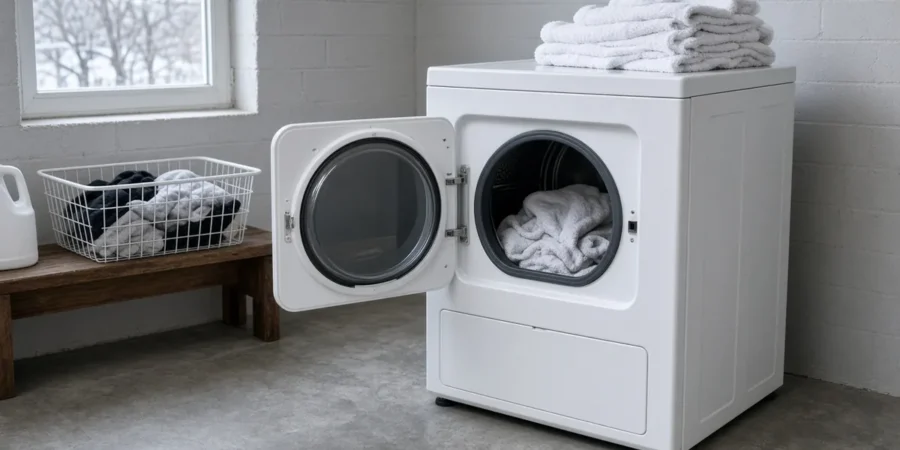
A dryer that tumbles but blows cold air is one of the most common calls we get. The good news is that a few of the causes are things you can check yourself in minutes. The rest come down to a small set of parts that wear out or protect the dryer when it overheats.
We only service electric appliances. If yours is a gas model, please contact a licensed gas fitter.
Before You Start: Safety
Unplug the dryer or switch off its breaker before you open any panel. Electric dryers run on 240 volts. Never bypass a thermal fuse or thermostat to “test” the dryer; those parts exist to stop fires.
1. Half of the Double Breaker Has Tripped
An electric dryer uses a double-pole breaker. The motor and drum can run on one half of the supply, while the heating element needs both. If one side trips, the dryer spins happily but makes no heat.
- Go to your electrical panel and find the dryer breaker (usually 30 amp, double-width).
- Switch it fully off, then back on. A breaker can look on while actually tripped.
- If it trips again, stop and call a technician or electrician. Something is drawing too much current.
2. A Clogged Lint Filter or Vent
A blocked vent is the root cause behind many no-heat problems. When hot air can’t escape, the dryer overheats, and its safety parts shut the heat off, sometimes for good (see the thermal fuse below).
- Clean the lint screen and look into the screen housing with a flashlight for packed lint.
- Go outside while the dryer runs. You should feel strong, warm airflow from the exterior hood, and the flap should open.
- Check the hose behind the dryer for kinks or crushing, especially if the dryer was pushed back against the wall.
3. Wrong Cycle or Settings
It sounds obvious, but check that the dryer isn’t on Air Fluff, Air Dry, Wrinkle Prevent, or a “no heat” option. Some models also have a delicate setting that runs so cool it feels unheated.
4. Blown Thermal Fuse
The thermal fuse is a one-time safety device on the exhaust path. If the dryer overheats, the fuse blows and cuts the heat (on many models it stops the dryer completely). A blown fuse is a symptom, not the root problem. In most cases the cause is a restricted vent, so replacing the fuse without clearing the vent means it will likely blow again.
With the power off, a thermal fuse can be tested for continuity with a multimeter. No continuity means it has blown.
5. Failed Heating Element
The element is a coil of resistance wire inside a metal housing. Over time the coil can break, or it can short against the housing. Signs include no heat at all, or heat that cuts out mid-cycle. A visual check (with the panel removed and power off) may show a visible break in the coil, and a multimeter test confirms it.
6. High-Limit or Cycling Thermostat
Dryers use thermostats to keep the drum within a safe range. The cycling thermostat switches the element on and off during normal drying. The high-limit thermostat is a backup that cuts heat if things get too hot. Either can fail open, leaving you with no heat.
7. Timer, Control Board or Sensor
On newer dryers, an electronic control decides when to power the heater. A faulty control or a failed temperature sensor (thermistor) can keep the element off. Some models show a code. For example, LG dryers use tE1 to tE6 for thermistor problems and nP when no current is reaching the heater, while Samsung dryers commonly show tO or tE for temperature-sensor faults, often linked to lint. Always confirm codes in your owner’s manual.
Quick Diagnosis Table
| What you notice | Most likely cause | DIY? |
|---|---|---|
| Drum spins, no heat at all, started suddenly | Tripped half of breaker, thermal fuse, element | Breaker yes; parts with care |
| Some heat, but loads take two cycles | Restricted vent, lint build-up | Yes |
| Heat cuts out partway through | Overheating from the vent, failing thermostat | Clean vent first |
| Dryer won’t start at all | Thermal fuse (some models), door switch, power | Check power; then call |
| Error code on the display | Sensor, heater circuit or airflow fault | Check vent, then call |
How to Prevent It Happening Again
- Clean the lint screen before or after every load.
- Have the vent run cleaned regularly and replace foil or plastic hose with semi-rigid or rigid metal duct.
- Don’t overload the drum. Packed loads restrict airflow and dry slowly.
- Leave a few centimetres of space behind the dryer so the hose isn’t crushed.
When to Call a Pro
Call a technician if the breaker trips again, the thermal fuse keeps blowing, you smell burning, or you have checked the breaker and vent and still have no heat. Testing elements, thermostats and controls means working inside a 240-volt appliance, and the root cause needs to be found, not just the failed part swapped.
Our dryer repair service covers electric dryers from LG, Samsung, Whirlpool, Maytag, Kenmore, GE, Frigidaire, Bosch, Electrolux and Miele.
Book a repair: call 647-642-1414 or book a visit online. We’re open 7 AM to 11 PM every day, statutory holidays included, at the same price, and we serve Toronto, North York, Scarborough and Etobicoke. The $70 service call is waived when you go ahead with the repair, and our repairs carry a 3 to 6 month warranty depending on the job. We’ve been fixing appliances since 2004 with licensed, insured and certified technicians. Read our 350+ Google reviews.
Frequently Asked Questions
Why is my dryer running but not getting hot?
On an electric dryer, the most common causes are a tripped half of the double breaker, a clogged vent that caused overheating, a blown thermal fuse, or a failed heating element or thermostat.
Can a clogged dryer vent stop the dryer from heating?
Yes. A restricted vent makes the dryer overheat, which can trip a thermostat or blow the thermal fuse and shut the heat off. Clean the vent before replacing parts.
Is it safe to bypass a dryer thermal fuse?
No. The thermal fuse is a fire-safety device. Bypassing it removes protection against overheating. Replace it with the correct part and fix the cause, usually airflow.
Should I repair or replace a dryer that won’t heat?
Many no-heat problems come down to a single part such as a fuse, thermostat or element, so repair is often worthwhile. A technician can confirm the cause before you decide.