
Quick answer
Why is my electric oven not heating?
Check the breaker first, then look for a broken bake or broil element. If the elements look fine, the cause is often a failed temperature sensor, relay, control board or a door lock stuck after self-clean.
When an electric oven won’t heat, most people assume a burnt-out element. Sometimes that’s true, and we have a separate guide to testing and replacing an oven element. But an oven is a small system: power from the panel, a control that decides when to heat, a sensor that reports the temperature, relays that switch the elements, and safety devices that can cut everything off. Any link in that chain can leave you with a cold oven. This guide walks through the whole chain in the order we’d check it.
We only service electric appliances. If yours is a gas model, please contact a licensed gas fitter.
Safety First
Switch off the range breaker before removing any panel, element, or the back cover. Electric ranges run on 240 volts, and parts can be live even when the oven is off at the control. Let the oven cool fully before working inside it.
Step 1: Narrow Down the Symptom
| What’s happening | Where to focus |
|---|---|
| Display and clock work, oven and cooktop both cold | Half of the double breaker, power supply |
| Cooktop works, oven doesn’t heat at all | Settings/modes, door lock, thermal fuse, control relays, both elements |
| Broil works, bake doesn’t (or the reverse) | The element that isn’t working, or its relay |
| Oven heats but slowly or never reaches set temperature | Partially failed element, temperature sensor, calibration, door seal |
| Oven overheats or burns food | Temperature sensor, stuck relay, calibration |
| Error code on the display | See the code table below |
Step 2: Check the Breaker
An electric range is fed by a double-pole breaker that supplies two “legs” of power. The clock, lights and controls can run on one leg, while the elements need both. If one half trips, the display looks perfectly normal but nothing heats.
- Switch the range breaker fully off, then firmly back on.
- If your home has fuses instead of breakers, a blown fuse on one leg causes the same symptom.
- If the breaker trips again right away or when the oven heats, stop. That points to a shorted element or wiring and needs a technician.
Step 3: Rule Out Settings and Modes
- Delay start or timed cook. If a delay is programmed, the oven waits before heating.
- Control lock. A locked control may ignore button presses.
- Sabbath mode. On models that have it, this mode changes how the oven responds and can make it seem unresponsive.
- Demo or showroom mode. Some ranges can be put into a demo mode where the display works but elements never heat. Your manual explains how to exit it.
Turning the breaker off for a minute and back on clears many control glitches.
Step 4: Test Each Heating Mode
Set Bake to 350°F and look through the window after several minutes: the bottom element should glow (on hidden-element models you’ll feel heat from the floor). Then try Broil and check the top element. If one glows and the other doesn’t, the problem is that element or the relay that powers it.
If neither element heats on any mode, a single shared part is more likely than two failed elements: the breaker, the thermal fuse, the door lock, the control board, or the sensor.
Step 5: Check the Door Lock
If the oven was recently self-cleaned, the door lock may not have fully released. Many ovens won’t bake while the control thinks the door is locked. Look for a lock light or icon. A breaker reset often clears it. Frigidaire ovens show F90 to F94 for door lock faults, and Samsung ovens commonly show C-d1. A lock motor or switch that has failed will need replacing.
Step 6: The Temperature Sensor
Most modern electric ovens use a temperature sensor, a thin metal probe usually mounted on the upper back wall inside the oven. The control reads its resistance to calculate the temperature.
- A sensor that fails open usually triggers an error code and the oven shuts off heat.
- A sensor that drifts can cause an oven to run cold, overheat, or take forever to preheat.
- Check that the probe isn’t touching the oven wall and that it isn’t bent or damaged.
Sensors can be tested with a multimeter against the manufacturer’s specification for your model, with the power off and the sensor disconnected. If the reading is out of range, replace it.
Step 7: Thermal Fuse and High-Limit
Many ovens have a thermal fuse or high-limit switch that cuts power if the cavity or control area overheats. They often blow during a self-clean cycle or because of a stuck relay or a failed cooling fan. A blown fuse usually means no heat at all, sometimes a blank display. Replacing the fuse without finding why it blew often leads to a repeat failure.
Step 8: The Control Board
The control board uses relays to switch each element on and off. A relay can weld itself shut (oven overheats, element won’t turn off) or fail open (element never gets power). If both elements test good, the breaker is fine, there’s no lock and no code, the control is the next suspect. Diagnosing a board involves live voltage checks and should be done by a technician.
Common Oven Error Codes Related to Heating
| Brand | Code | Common meaning |
|---|---|---|
| Frigidaire / Electrolux | F10 | Runaway temperature (oven too hot) |
| Frigidaire / Electrolux | F30 | Open temperature sensor circuit |
| Whirlpool / Maytag / KitchenAid | F3 E0 | Temperature sensor fault |
| LG | F-9 | Oven didn’t reach 150°F within 5 minutes of preheat |
| LG | F-1 / F-2 | Commonly indicates a sensor or temperature fault |
| Samsung | C-20 | Temperature sensor |
| Samsung | C-21 | Overheating |
Codes can vary by model, so confirm in your owner’s manual. A code that comes back after a breaker reset usually needs a technician.
Oven Heats But Runs Cold
If the oven heats but your food takes longer than the recipe says:
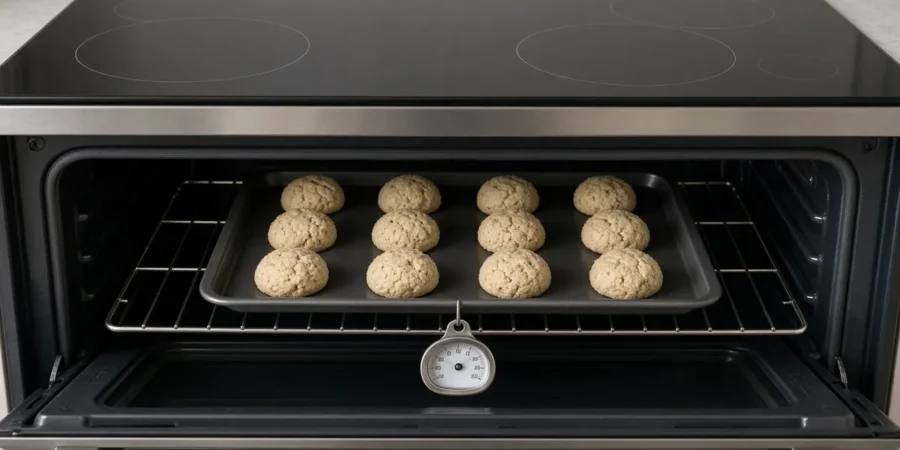
- Put an oven thermometer on the middle rack, set 350°F, and wait 20 minutes after the preheat signal.
- Read the thermometer without opening the door, if possible.
- If it’s consistently off, many ovens let you adjust the calibration offset from the control panel (see your manual).
- Check the door gasket for gaps or tears. A worn seal leaks heat.
- If the temperature swings widely or the offset doesn’t fix it, the sensor or an element may be weak.
When to Call a Pro
Call a technician if the breaker trips, both elements are good but the oven won’t heat, the door stays locked, a code returns after a reset, or the oven overheats. These point to sensors, fuses, relays or wiring, all of which need live testing on a 240-volt appliance.
Our oven and stove repair technicians diagnose and fix electric ovens and ranges from LG, Samsung, Frigidaire, Whirlpool, GE, KitchenAid, Bosch and more.
Book a repair: call 437-662-1414 or book a visit online. We’re open 7 AM to 11 PM every day, statutory holidays included, at the same price, and we serve Toronto, North York, Scarborough and Etobicoke. The $70 service call is waived when you go ahead with the repair, and our repairs carry a 3 to 6 month warranty depending on the job. We’ve been fixing appliances since 2004 with licensed, insured and certified technicians. Read our 350+ Google reviews.
Frequently Asked Questions
Why is my electric oven not heating but the stovetop works?
If the cooktop works, power to the range is fine. Look at oven-specific causes: a failed element, a stuck door lock, a blown thermal fuse, a faulty temperature sensor, or a control board relay.
Why does my oven clock work but the oven won’t heat?
The clock can run on one side of the 240-volt supply. If half of the double breaker has tripped, the display works but the elements get no power. Reset the breaker fully.
How do I know if my oven temperature sensor is bad?
Signs include error codes, an oven that runs very hot or cold, or long preheats. With the power off, a technician can test the sensor’s resistance against the manufacturer’s specification.
Can I fix an oven that won’t heat myself?
You can check the breaker, settings and door lock, and replace an exposed element. Sensors, thermal fuses and control boards are better left to a technician because they require live electrical testing.