
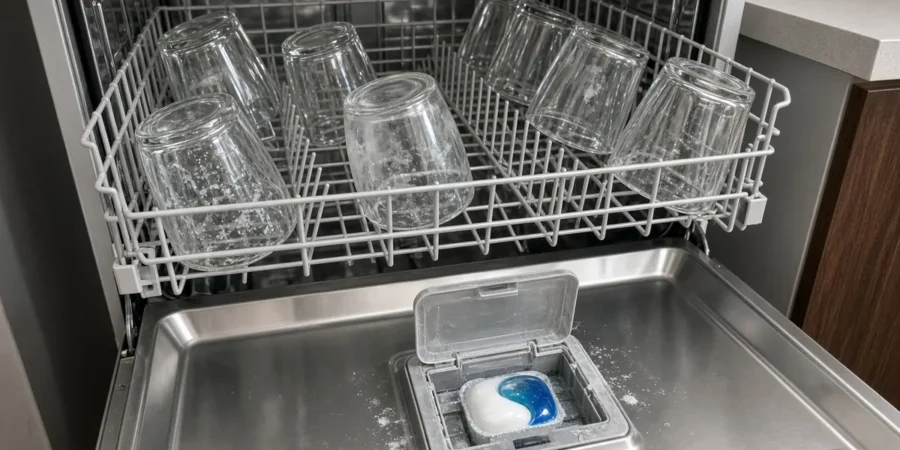
Quick answer
Why is my dishwasher not cleaning dishes properly?
Usually a dirty filter, clogged spray arms, water that isn't hot enough, too little or old detergent, or dishes blocking the spray. Clean the filter and spray arms and run the kitchen tap hot before starting a cycle.
When a dishwasher stops cleaning well, it usually happens gradually: a little grit on glasses, food stuck in bowls, a film that wasn’t there before. Most causes are simple to fix and come down to water flow, water temperature, detergent, or loading.
Safety First
Switch off the dishwasher at the breaker (or unplug it) before removing the filter, spray arms or any internal part.
1. A Dirty Filter
Most modern dishwashers have a manual filter that needs regular cleaning. When it’s clogged, dirty water recirculates and redeposits food on dishes. Remove the bottom rack, twist out the filter, rinse it under warm water, and scrub gently with a soft brush. Bosch dishwashers commonly show E22 and Frigidaire/Electrolux models i40 when the filter needs attention.
2. Blocked Spray Arms
Food bits, seeds and limescale can block the small holes in the spray arms.
- Spin each arm by hand. It should turn freely.
- Remove the arms (most unclip or unscrew; check your manual).
- Clear each hole with a toothpick and rinse the arm.
- Reinstall and make sure the arms spin.
3. Loading Problems
- Don’t overcrowd. Water needs to reach every surface.
- Face dirty sides toward the spray arms.
- Make sure tall items, pans or utensils don’t block the spray arms or the detergent dispenser door.
- Put bowls and cups at an angle so water doesn’t pool.
4. Water Not Hot Enough
Dishwashers clean best with hot water. Before starting a cycle, run the hot tap at the kitchen sink until it’s hot, so the dishwasher fills with hot water from the start. If dishes are consistently poorly cleaned and the interior feels cool after a cycle, the heating element or its control may have failed. LG dishwashers can show HE and Samsung HE for a heating problem; Bosch E09 commonly indicates a heating element fault.
5. Wrong Detergent or Amount
- Use only automatic dishwasher detergent, never hand dish soap.
- Old or clumped powder detergent works poorly. Store detergent in a dry place.
- Pods are convenient, but put them in the dispenser (not loose in the tub) unless the brand says otherwise.
- Too little detergent leaves food; too much can leave film.
6. No Rinse Aid
Rinse aid helps water sheet off dishes, improving drying and reducing spots. Most dishwashers have a separate rinse-aid dispenser and an indicator light. If you’ve stopped using it, try it again.
7. Hard Water and Limescale
Hard water leaves white film on glasses and the interior, and can clog spray arm holes. Run an empty cycle with a dishwasher cleaner, or with a cup of white vinegar upright on the top rack (if your manual allows). Some dishwashers, such as many Bosch and Miele models, have a built-in water softener with a salt reservoir, so check that it’s filled and set correctly.
8. Short or Eco Cycles
Quick and eco cycles use less water and energy, and may not handle heavily soiled loads. Try a normal or heavy cycle for tough dishes.
9. Failed Parts
If the basics are covered, a part may have failed:
- Circulation (wash) pump: weak spray pressure.
- Inlet valve: not enough water entering.
- Heating element: water stays cool.
- Detergent dispenser: door doesn’t open, so detergent stays in the cup.
Check the dispenser after a cycle. If the detergent is still there, the door was blocked or the dispenser mechanism has failed.
Quick Troubleshooting Table
| Symptom | Likely cause |
|---|---|
| Gritty residue on dishes | Dirty filter, blocked spray arms |
| Cloudy glasses, white film | Hard water, no rinse aid |
| Detergent left in dispenser | Blocked dispenser door, failed dispenser |
| Top rack dirty, bottom fine | Blocked upper spray arm, water supply |
| Dishes cold and greasy | Water not hot, heating problem |
If water is also left in the tub, see our guide to a dishwasher not draining.
When to Call a Pro
Call a technician if the filter and spray arms are clean, loading and detergent are right, and dishes still come out dirty, or if water doesn’t get hot, the dispenser doesn’t open, or you hear weak spray. These point to pump, valve, heater or control problems.
See our dishwasher repair service. We work on Bosch, Miele, KitchenAid, Whirlpool, Samsung, LG and more.
Book a repair: call 437-662-1414 or book a visit online. We’re open 7 AM to 11 PM every day, statutory holidays included, at the same price, and we serve Toronto, North York, Scarborough and Etobicoke. The $70 service call is waived when you go ahead with the repair, and our repairs carry a 3 to 6 month warranty depending on the job. We’ve been fixing appliances since 2004 with licensed, insured and certified technicians. Read our 350+ Google reviews.
Frequently Asked Questions
Why is my dishwasher leaving food on dishes?
Common causes are a dirty filter, blocked spray arms, overcrowding, water that isn’t hot enough, or the wrong amount of detergent. Clean the filter and spray arms first.
Why are my glasses cloudy after the dishwasher?
Cloudy glasses are usually from hard water or a lack of rinse aid. Use rinse aid, run a cleaning cycle, and check the softener settings if your model has one.
How often should I clean my dishwasher filter?
Many manufacturers suggest about once a month, and more often if you don’t scrape dishes or run the dishwasher daily.
Why is detergent left in my dishwasher after a cycle?
The dispenser door may be blocked by a tall item, or the dispenser itself may have failed. Rearrange the load first, and call for service if it still doesn’t open.