
Quick answer
Why does my dishwasher smell and leave dishes wet?
Trapped food in the filter, standing water from poor drainage and a missing rinse aid are the usual causes. Clean the filter, check the drain, use rinse aid and run a hot empty cycle with a dishwasher cleaner.
Two of the most common dishwasher complaints are a bad smell and dishes that come out wet. They often go together: moisture, trapped food and poor drainage are behind both. Here’s how to fix them.
Safety First
Switch off the dishwasher at the breaker (or unplug it) before removing the filter, spray arms or any panel. Let the heating element cool if a cycle just finished.
Part 1: Why Your Dishwasher Smells
1. A dirty filter
This is the number one cause. Food collects in the filter and starts to rot. Remove the bottom rack, twist out the filter, and wash it with warm, soapy water and a soft brush. Clean the area under it too.
2. Food trapped in the door gasket and tub edges
Wipe the door seal, the bottom edge of the door, and the corners of the tub. Food and grease hide here.
3. Standing water
If water sits in the bottom after a cycle, it’ll smell. That points to a drain problem: a clogged filter, kinked hose, blocked disposer or air gap. See our guide to a dishwasher not draining.
4. Drain backflow
If the drain hose doesn’t have a high loop (secured up under the countertop) or an air gap, dirty water from the sink or disposer can flow back into the dishwasher. That causes a sewer-like smell. Check under the sink: the hose should rise up before dropping to the drain connection.
5. Infrequent use
If dishes sit in the dishwasher for days before you run it, food dries and smells. Use a rinse-only cycle to rinse dishes until you have a full load.
6. Build-up of grease and residue
Run an empty hot cycle with a dishwasher cleaner, following the product directions. Some people use a cup of white vinegar upright on the top rack; check your manual first.
How to deep clean a smelly dishwasher
- Remove and clean the filter.
- Remove and clean the spray arms, clearing holes with a toothpick.
- Wipe the door gasket, door edge and tub corners.
- Run the garbage disposer and check the drain hose loop.
- Run an empty hot cycle with a dishwasher cleaner.
- Leave the door slightly open afterward so the interior dries.
Part 2: Why Dishes Aren’t Drying
1. No rinse aid
Rinse aid is one of the biggest factors in drying, especially for modern dishwashers that don’t use a heated drying element. It helps water sheet off instead of beading. Fill the rinse-aid dispenser and see if drying improves.
2. How your dishwasher dries
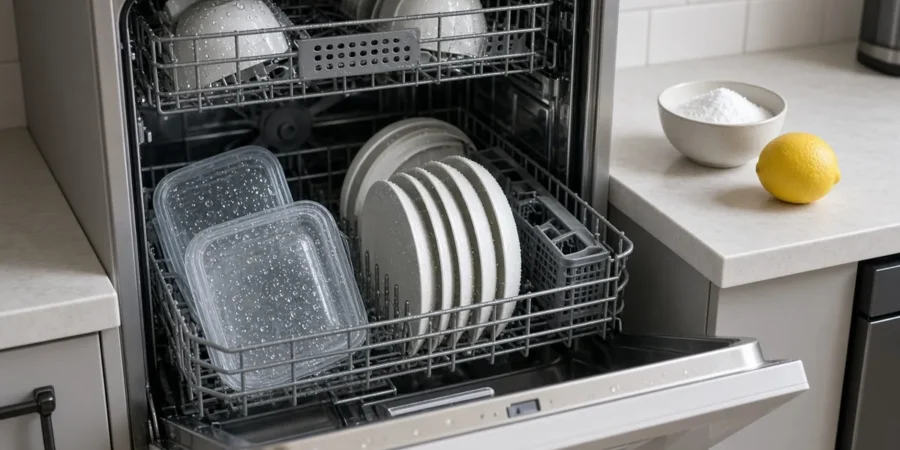
Many dishwashers, including many European models such as Bosch and Miele, use condensation drying: the final rinse is hot, and moisture condenses on the cooler stainless tub walls. Plastic items often stay wet with this method, because plastic doesn’t hold heat. That’s normal. Other dishwashers use a heating element or a fan to assist drying.
3. Drying settings
Check for a heated dry, extra dry, or similar option. Eco cycles often use less heat and leave dishes wetter.
4. Unloading order
Unload the bottom rack first. Water from cups on the top rack often drips onto the dishes below.
5. Loading
Overcrowding traps moisture. Angle cups and bowls so water runs off, and avoid nesting items.
6. Water not hot enough
Run the kitchen tap until it’s hot before starting the dishwasher. Hot dishes dry better.
7. A failed heating element, fan or vent
If your dishwasher normally dries well and suddenly stops, and dishes are also coming out cool, the heating element, drying fan, or vent may have failed. On LG and Samsung dishwashers, an HE code commonly indicates a heating problem, and on Bosch, E09 commonly indicates a heating circuit fault.
Quick Fix Summary
| Problem | Try this first |
|---|---|
| Rotten food smell | Clean the filter and door gasket |
| Sewer smell | Check the drain hose loop or air gap, clean the disposer |
| Standing water | Clear the filter, hose and drain |
| Plastics wet | Normal with condensation drying; use rinse aid |
| Everything wet | Rinse aid, drying setting, hot water at sink |
| Suddenly not drying, dishes cool | Possible heater or fan failure; call |
When to Call a Pro
Call a technician if your dishwasher still smells after a deep clean, has standing water that won’t clear, or has suddenly stopped drying and heating. Drain pumps, check valves, heaters and fans can all be replaced, and we can check the drain hose installation while we’re there.
See our dishwasher repair service. We repair Bosch, KitchenAid, Miele, Whirlpool, Samsung, LG and more.
Book a repair: call 437-662-1414 or book a visit online. We’re open 7 AM to 11 PM every day, statutory holidays included, at the same price, and we serve Toronto, North York, Scarborough and Etobicoke. The $70 service call is waived when you go ahead with the repair, and our repairs carry a 3 to 6 month warranty depending on the job. We’ve been fixing appliances since 2004 with licensed, insured and certified technicians. Read our 350+ Google reviews.
Frequently Asked Questions
Why does my dishwasher smell like rotten eggs or sewage?
A sewer smell often comes from drain backflow when the drain hose has no high loop or air gap, or from a dirty filter and standing water. Clean the filter and check the drain hose.
Why are my plastic dishes always wet after the dishwasher?
Many dishwashers dry by condensation, and plastic doesn’t hold enough heat for moisture to evaporate. Using rinse aid helps, but some water on plastics is normal.
Does rinse aid really help drying?
Yes. Rinse aid helps water sheet off dishes instead of forming droplets, which improves drying, especially in dishwashers that use condensation drying.
How do I get rid of dishwasher odour?
Clean the filter, spray arms and door gasket, make sure it drains fully, and run an empty hot cycle with a dishwasher cleaner. Leave the door slightly open afterward.