
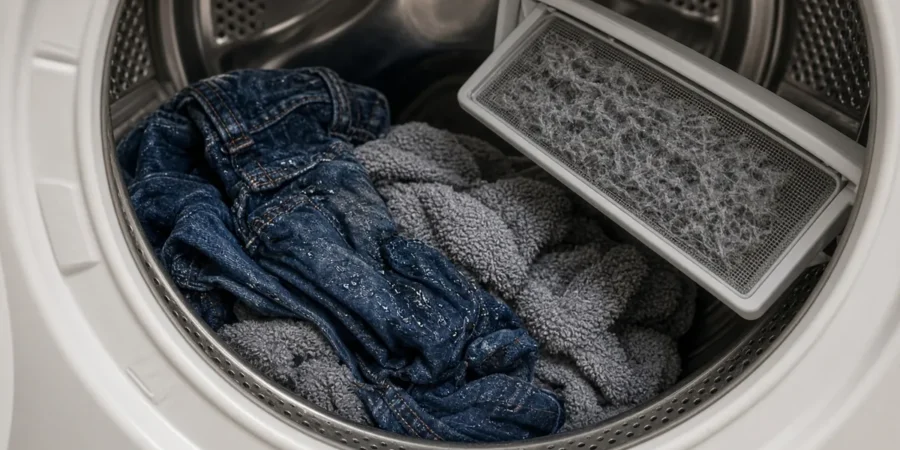
Your dryer heats, the drum turns, and the cycle ends, yet the towels are still damp. Or every load needs a second run. This is different from a dryer that produces no heat at all (see our guide to a dryer not heating). Here the dryer is working, just not well enough. In most cases the cause is airflow, the load itself, or the sensor that decides when clothes are dry.
Safety First
Unplug the dryer or switch off its breaker before pulling it out, disconnecting the vent hose, or cleaning inside the lint housing.
1. A Full or Coated Lint Screen
A full screen reduces airflow right away. Even a screen that looks clean can be coated with a nearly invisible film from dryer sheets and fabric softener. Test it: run water over it. If water pools instead of flowing through, wash it with warm, soapy water and a soft brush, then let it dry completely.
2. Restricted Vent
This is the most common reason clothes take too long to dry. Moist air needs to leave the dryer. If the vent is long, crushed or packed with lint, moisture stays in the drum.
- With the dryer running, go outside and feel the exhaust. It should be strong and warm.
- Check the hose behind the dryer for kinks.
- Clean the full vent run. Our step-by-step guide to cleaning a dryer vent covers it.
3. Overloading
Clothes need room to tumble so hot air can pass through them. A drum packed to the top dries slowly and unevenly. As a rule of thumb, a load should fill no more than about three-quarters of the drum. Bulky items like duvets may need to be dried alone.
4. Clothes Coming Out of the Washer Too Wet
If your washer isn’t spinning properly, clothes go into the dryer dripping wet. Lift a load from the washer: it should feel damp, not soaked. If it’s dripping, the problem is the washer’s spin or drain. Check that the washer drains fully and that you’re using a spin speed suited to the fabric.
5. Dirty Moisture Sensor
Most modern dryers have sensor bars, two metal strips usually inside the drum near the lint screen. They detect moisture as wet clothes brush against them. When they’re coated with fabric softener or dryer-sheet residue, the dryer “thinks” clothes are dry and ends the cycle early.
- Unplug the dryer.
- Locate the metal strips (check your manual).
- Wipe them with a soft cloth dampened with rubbing alcohol or a little white vinegar.
- Dry them and test with a sensor dry cycle.
LG dryers can show an HS code for a humidity-sensor problem; cleaning the sensor bars is the first step.
6. Wrong Cycle
Sensor cycles such as Normal or Cottons stop based on dryness level. If clothes are consistently damp, try a higher dryness setting. Timed dry on a low heat setting will also leave heavy items damp. Mixing towels with lightweight shirts in one load means the light items dry and the towels don’t.
7. Cold Laundry Room
An unheated basement or garage in a Toronto winter can lengthen drying times. The dryer has to heat cold intake air first. It’s not a fault, but it adds minutes.
8. Partial Heat Loss
If the dryer feels only lukewarm, a part may be failing. A heating element can lose part of its coil, a cycling thermostat may be cutting heat too soon, or the dryer may be on only half of its 240-volt supply. These cases sit somewhere between “not drying” and “not heating”.
Troubleshooting Summary
| Symptom | Likely cause | Fix |
|---|---|---|
| Clothes hot but damp | Restricted vent | Clean the vent run |
| Cycle ends too early | Dirty moisture sensor, wrong dryness level | Clean sensor bars; raise dryness |
| Some items dry, some wet | Overloading, mixed fabric weights | Smaller, sorted loads |
| Clothes soaked before drying | Washer not spinning or draining | Check the washer |
| Barely warm air | Failing element, thermostat, power | Call a technician |
When to Call a Pro
If you’ve cleaned the lint screen, vent and sensor bars and loads still don’t dry, it’s time for a diagnosis. A technician can check heat output, thermostats, the element and airflow inside the cabinet, where lint can collect out of reach.
See our dryer repair service, or if the problem starts in the washer, our washer repair page.
Book a repair: call 647-642-1414 or book a visit online. We’re open 7 AM to 11 PM every day, statutory holidays included, at the same price, and we serve Toronto, North York, Scarborough and Etobicoke. The $70 service call is waived when you go ahead with the repair, and our repairs carry a 3 to 6 month warranty depending on the job. We’ve been fixing appliances since 2004 with licensed, insured and certified technicians. Read our 350+ Google reviews.
Frequently Asked Questions
Why does my dryer take two cycles to dry clothes?
The most common reasons are a restricted vent, a coated lint screen, overloading, or clothes coming out of the washer too wet. Start by cleaning the lint screen and vent.
How do I clean my dryer’s moisture sensor?
Unplug the dryer, find the metal sensor strips inside the drum, and wipe them with a cloth dampened with rubbing alcohol or white vinegar. Dry them before using the dryer.
Can fabric softener stop a dryer from drying?
Yes. Residue from softener and dryer sheets can coat the lint screen and the moisture sensor, reducing airflow and making the dryer end cycles too early.
Why are my clothes hot but still damp?
Hot but damp clothes usually point to poor airflow. The heat is there, but moist air can’t leave the drum. Check and clean the vent run and exterior hood.